
Do you often wonder if you can still build muscle while cutting calories? You’re not alone.
Many people like you are trying to achieve that lean, toned body without piling on extra pounds. It seems like a tough balancing act, doesn’t it? But what if I told you it’s possible to sculpt those muscles even when you’re on a calorie deficit?
Intrigued? You should be. This article will unravel the secrets behind muscle growth and calorie management, providing you with the insights and strategies you need. Stick around, because understanding this could be the game-changer in your fitness journey. Ready to dive in? Let’s explore how you can turn this perceived challenge into your strongest asset.
Muscle Growth And Calorie Deficit
Muscle growth and calorie deficit often seem like opposing goals. Building muscle usually requires extra energy, while a calorie deficit means eating fewer calories than your body needs. Understanding how muscle grows and how a calorie deficit affects this process helps clarify what is possible.
How Muscle Builds
Muscle grows through a process called hypertrophy. This happens when muscle fibers sustain small injuries during exercise. The body repairs these fibers by adding new protein strands. This repair makes muscles thicker and stronger.
Protein intake and strength training are key factors. Consuming enough protein provides the building blocks. Lifting weights or resistance training causes the muscle damage needed to start growth. Rest and recovery time allow muscles to rebuild properly.
Impact Of Calorie Deficit On Muscle
A calorie deficit means your body gets less energy than it burns daily. This can make muscle growth harder. The body may lack enough fuel to repair and build new muscle tissue fully.
However, muscle gain is still possible in a calorie deficit with the right approach. Eating enough protein helps protect muscle mass. Strength training signals your body to keep muscle despite fewer calories. The process is slower than with a calorie surplus.
Fat loss often happens alongside muscle gain in a deficit. This can improve muscle definition and overall body shape. Patience and consistency in diet and exercise are important for success.
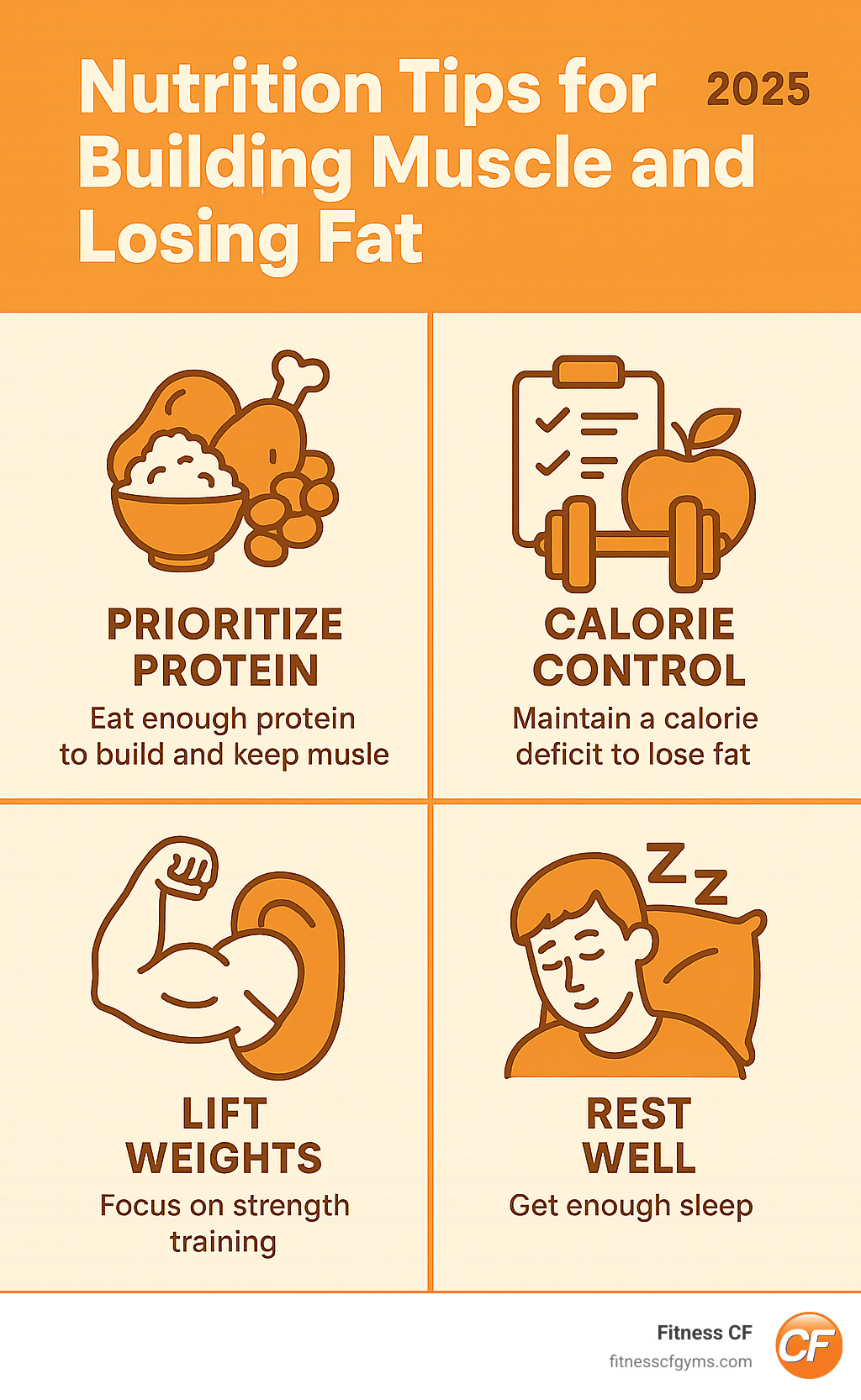
Credit: fitnesscfgyms.com
Key Factors For Muscle Gain In Deficit
Building muscle while in a calorie deficit can feel like a tricky challenge. Your body needs energy to repair and grow muscles, yet consuming fewer calories means less fuel. However, focusing on key factors like protein intake, training methods, and recovery can tip the scales in your favor.
Protein Intake Essentials
Protein is your muscle-building block. Eating enough protein helps preserve muscle mass even when calories are low. Aim for about 1.6 to 2.2 grams of protein per kilogram of your body weight daily.
Spread your protein evenly across meals to keep your muscles fed throughout the day. Including sources like chicken, eggs, fish, beans, and dairy ensures you get all essential amino acids. Have you checked if your meals hit this target?
Strength Training Strategies
Training smart is crucial when you’re in a calorie deficit. Focus on lifting heavy enough weights to challenge your muscles but avoid pushing to total failure every session. Consistency beats occasional intense workouts.
Compound movements like squats, deadlifts, and bench presses recruit multiple muscle groups. These exercises give you the most bang for your buck, helping maintain and build muscle efficiently. How often do you track your progress to adjust weights or reps?
Recovery And Sleep
Muscle grows outside the gym during rest. Lack of sleep and poor recovery can stall your progress, especially on fewer calories. Aim for 7 to 9 hours of quality sleep each night to support muscle repair.
Include rest days in your routine to avoid overtraining. Stress management techniques like meditation or light walking can also improve recovery. Are you giving your body the rest it needs to grow stronger?
Effective Workout Plans
Effective workout plans are essential when you want to build muscle while eating fewer calories. Your body needs the right kind of stimulus to grow muscle, even if you’re in a calorie deficit. Crafting a workout strategy that maximizes muscle retention and growth can make a big difference in your results.
Resistance Training Focus
Resistance training is your best friend for building muscle on a calorie deficit. Lifting weights or using resistance bands sends a signal to your body that muscle is needed, so it won’t break down existing muscle tissue for energy. You don’t have to lift super heavy every time, but you do need to challenge your muscles consistently.
Try to focus on compound movements like squats, deadlifts, and bench presses. These exercises work multiple muscle groups at once and give you more bang for your buck. Have you noticed how your strength improves when you stick to these key lifts? That progress is a sign your muscles are responding.
Incorporating Progressive Overload
Progressive overload means gradually making your workouts harder to keep your muscles adapting. This can be done by adding more weight, increasing reps, or improving your form. Without this step, your muscles won’t have a reason to grow.
Track your workouts so you know when to push harder. For example, if you lifted 50 pounds for 8 reps last week, try 52 pounds or 9 reps this week. Small increases add up fast and keep your muscles guessing.
Have you ever hit a plateau in your training? Progressive overload helps you break through that by constantly challenging your body.

Credit: homegymsupply.co.uk
Nutrition Tips For Success
Building muscle while in a calorie deficit is challenging but possible with the right nutrition strategy. Your body needs enough fuel to repair and grow muscle even when you’re eating less overall. Focus on precise nutrition choices that support muscle maintenance without hindering fat loss.
Balancing Macronutrients
Protein is your best friend when trying to build muscle on fewer calories. Aim for about 1.0 to 1.2 grams of protein per pound of body weight daily to keep muscle breakdown at bay.
Don’t neglect carbs and fats—they provide energy and support hormone health. Prioritize complex carbs like oats and sweet potatoes, and healthy fats from sources like avocados and nuts.
Think about your plate like this:
- 40% proteinto support muscle repair
- 30% carbsfor energy and recovery
- 30% fatsto keep hormones balanced
Timing Your Meals
When you eat can be as important as what you eat. Try to have a protein-rich meal or snack within 30 minutes after your workout to maximize muscle repair.
Spreading your meals evenly throughout the day can also help keep your energy steady and prevent muscle loss. Eating every 3-4 hours ensures your muscles get a constant supply of nutrients.
Have you noticed how skipping meals makes you feel weaker during workouts? That’s your body telling you it needs fuel to build strength.
Hydration Importance
Water plays a key role in muscle function and recovery. Even mild dehydration can reduce strength and slow down muscle growth.
Drink at least 3 liters of water daily, and increase that amount if you sweat a lot during workouts. Adding electrolytes can help maintain balance when you’re sweating heavily.
Next time you feel sluggish in the gym, ask yourself if you’ve had enough water today—it might be the simplest fix to boost your performance.
Common Challenges
Building muscle on a calorie deficit is a tough balance. Your body needs enough energy to repair and grow muscle, but cutting calories means less fuel overall. Facing common challenges head-on can help you stay on track and make real progress.
Avoiding Muscle Loss
When calories are low, your body may break down muscle for energy. To protect your gains, focus on eating enough protein—aim for about 1.6 to 2.2 grams per kilogram of body weight daily. Pair this with resistance training to send a clear signal to your body: “Keep the muscle, we need it!”
Have you noticed how lifting heavy weights even on low calories helps maintain strength? That’s your muscle telling you it’s worth preserving.
Preventing Fatigue
Cutting calories can leave you feeling drained, making workouts harder and recovery slower. To fight fatigue, prioritize nutrient timing—eat carbs around your workouts to fuel performance and speed up recovery. Also, don’t underestimate the power of quality sleep; it’s when your muscles rebuild and energy restores.
What happens if you push through exhaustion without adjusting your diet or rest? You risk burning out and losing muscle instead of gaining it.
Managing Hunger
Staying in a calorie deficit often means dealing with hunger pangs. Combat this by choosing foods that fill you up without adding too many calories—think high-fiber veggies, lean proteins, and healthy fats. Drinking water regularly can also help curb unnecessary snacking.
Ever tried eating more volume with fewer calories? It’s a simple trick that keeps you full and focused on your muscle-building goals.
Supplements That Help
Building muscle on a calorie deficit is tough but possible. Proper nutrition alone might not be enough. Supplements can support muscle growth and recovery. They help fill gaps in diet and boost workout results. Here are some key supplements to consider.
Protein Powders
Protein is essential for muscle repair and growth. Protein powders provide a quick, easy source of high-quality protein. They help meet daily protein needs without extra calories. Whey, casein, and plant-based options suit different preferences. Consuming protein powder after workouts aids muscle recovery.
Branched-chain Amino Acids
Branched-Chain Amino Acids (BCAAs) include leucine, isoleucine, and valine. These amino acids help reduce muscle breakdown during calorie deficit. BCAAs also promote muscle protein synthesis. Taking BCAAs before or during exercise may reduce fatigue. They support muscle maintenance when calorie intake is low.
Creatine Benefits
Creatine increases strength and power during workouts. It helps muscles perform better, even with fewer calories. Creatine improves energy production in muscle cells. Regular use can lead to greater muscle gains over time. It supports muscle endurance and recovery after exercise.
Tracking Progress
Tracking progress is vital when building muscle on a calorie deficit. It helps to see real changes beyond just weight on the scale. Progress can be subtle and slow, so accurate tracking keeps motivation high. It also guides adjustments in diet and training for better results.
Measuring Strength Gains
Strength gains show muscle growth even if weight drops. Track your performance in key exercises like squats, deadlifts, and bench presses. Note the weight lifted, sets, and reps each session. Increasing strength over weeks signals muscle development.
Keep a training log or use apps to record workouts. Consistent strength improvements mean your muscles adapt despite calorie shortage. If strength stalls or drops, it may need diet or training changes.
Body Composition Analysis
Body composition reveals muscle versus fat changes. Use tools like skinfold calipers, bioelectrical impedance scales, or professional scans. Track measurements regularly, about every 2-4 weeks.
Look for reduced fat and maintained or increased muscle mass. Even if body weight falls, better muscle to fat ratio means progress. Photos and tape measurements help visualize changes.
Accurate tracking shows whether muscle is preserved or lost. This guides tweaks in calories, protein intake, and workouts to keep muscle growing on a deficit.

Credit: www.fit3d.com
Frequently Asked Questions
Can I Build Muscle While Eating Fewer Calories?
Yes, building muscle on a calorie deficit is possible with proper training. Focus on strength workouts and consume enough protein. Your body will use stored fat for energy, supporting muscle growth even with fewer calories.
How Much Protein Is Needed During A Calorie Deficit?
Aim for 1. 2 to 2. 0 grams of protein per kilogram of body weight. Protein supports muscle repair and growth, especially when calories are limited. This ensures you maintain muscle mass while losing fat.
What Type Of Exercise Helps Build Muscle In A Deficit?
Strength training or resistance exercises are best. These workouts stimulate muscle growth and prevent muscle loss during calorie restriction. Combine with proper nutrition for effective results.
Can Beginners Build Muscle On A Calorie Deficit?
Yes, beginners often gain muscle while losing fat. Their bodies respond quickly to strength training. However, experienced lifters may find it harder to gain muscle without a calorie surplus.
Conclusion
Building muscle on a calorie deficit is possible but challenging. Focus on eating enough protein to support muscle growth. Train with weights regularly and rest well to help muscles recover. Track your progress and adjust calories as needed. Small gains take time and patience.
Stay consistent and listen to your body. This approach helps you lose fat and keep muscle. Balance is key for the best results. Keep your goals realistic and enjoy the journey.







