
Are you looking to make your gym design projects stand out? Using the right Gym Equipment Revit Family can transform your plans from ordinary to extraordinary.
Imagine having detailed, ready-to-use models that save you time and help you visualize every corner of your space perfectly. You’ll discover how these Revit families can boost your productivity and bring your ideas to life with ease. Keep reading to find out how to choose and use the best gym equipment models for your next project.
Credit: www.cgtrader.com
Choosing Gym Equipment Families
Choosing the right gym equipment families in Revit can make a big difference in how smoothly your project comes together. The right selection not only improves the visual accuracy of your designs but also ensures that the equipment fits perfectly within your space and meets the functional needs of your clients. Have you ever struggled to find a Revit family that matches both the style and specifications you require? Understanding what’s available and what features to prioritize can save you hours of frustration.
Types Of Gym Equipment In Revit
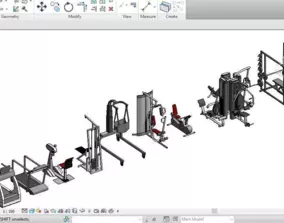
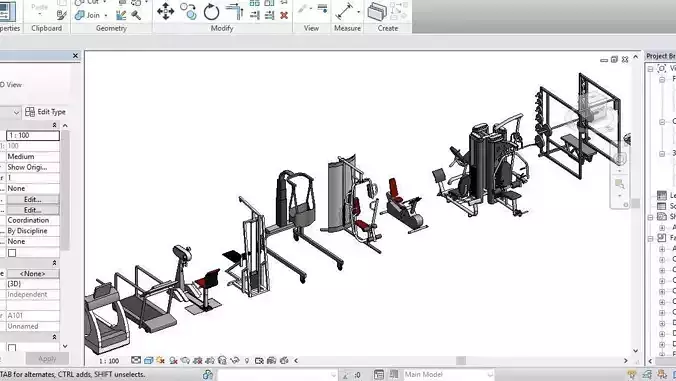
Revit offers a variety of gym equipment families, each designed to represent different workout zones and functions. You’ll find families for:
- Cardio Machines:treadmills, ellipticals, stationary bikes
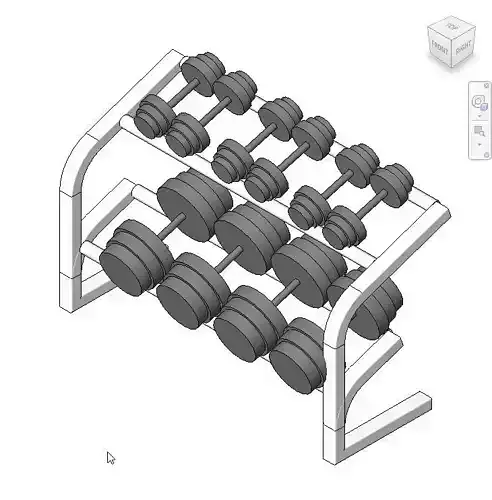
- Strength Training:weight benches, squat racks, cable machines
- Functional Training:kettlebells, medicine balls, battle ropes
- Accessories:mats, lockers, water stations
Choosing from these categories depends on your project’s focus. Are you designing a high-end fitness center or a basic community gym? Each type comes with different levels of detail, so pick what matches your project’s scale and purpose.
Key Features To Consider
When selecting gym equipment families, consider these features carefully:
| Feature | Why It Matters | What to Look For |
|---|---|---|
| Level of Detail | Impacts how realistic your model looks | Choose families with detail that fits your project stage (LOD) |
| Dimensions & Scale | Ensures accurate space planning | Verify exact measurements and clearance requirements |
| Parametric Controls | Allows easy adjustments without remodeling | Look for adjustable height, width, or component options |
| Compatibility | Prevents conflicts with other elements | Check if the family works well with your Revit version and other families |
I once chose a detailed treadmill family without checking its dimensions and ended up with a tight fit that blocked walkways. That taught me to double-check measurements before finalizing any family. What’s your experience with fitting equipment in tight spaces? Taking time to review these features can prevent costly redesigns later on.
Creating Custom Families
Customizing gym equipment families in Revit helps create accurate, detailed models for any project. Designers can tailor sizes, shapes, and features to match real-world gym setups. This improves visualization and planning during the design process.
Creating Custom Families Creating custom gym equipment families in Revit is a game-changer for architects and designers. You can tailor each piece to fit the unique needs of your project. This flexibility not only enhances the design but also ensures functionality and efficiency.Setting Up Parameters
Setting up parameters is crucial in defining your gym equipment’s attributes. Parameters allow you to control dimensions, materials, and visibility. Consider what aspects of the equipment need flexibility, such as adjustable bench heights or different color options. You can create shared parameters if the same attribute needs to apply across multiple families. This ensures consistency and saves time. Remember, the more precise your parameters, the more detailed and adaptable your models will be.Modeling Techniques
Modeling techniques in Revit can vary based on the complexity of the gym equipment. Start with basic shapes and gradually refine them. Use extrusion and sweep commands to add detail and intricacy. Think of the gym equipment you’ve used: a treadmill isn’t just a flat surface but includes handles, a display, and a belt. Break down these components and model them step by step. Don’t forget to use reference planes to maintain alignment and accuracy.Adding Materials And Textures
Adding materials and textures can bring your Revit models to life. Realistic textures help clients visualize the final product. Select materials that reflect the true characteristics of the gym equipment, like rubber for grips or metal for frames. Test different textures to see how lighting affects them. This can dramatically change the appearance and feel of your design. Incorporating realistic materials enhances the overall aesthetic and helps in making informed decisions during the planning phase. Creating custom families in Revit not only enhances your design’s precision but also elevates the entire project experience. What unique attributes would you add to make your gym equipment stand out?Optimizing Families For Performance
Optimizing Gym Equipment Revit families is essential for smooth project performance and efficient workflow. Large or overly detailed families can slow down your model, making it frustrating to work with. The goal is to keep your families as lightweight as possible while maintaining the necessary detail for accurate representation.
Reducing File Size
One of the easiest ways to improve performance is by reducing the file size of your families. Start by removing unnecessary geometry or overly complex details that won’t be visible in your project views.
Think about what really matters in the model. For example, small bolts or fine textures might look great but add bulk without real benefit. Simplify these elements or replace them with symbolic representations to keep your family lean.
Using Lod (level Of Detail)
LOD controls how much detail is shown depending on the view scale or phase of the project. You can create multiple versions of the same family with different detail levels.
At a distance, show a simplified version of the equipment. When zoomed in, display more detail. This saves processing power and helps your project run faster.
Have you tried setting up LOD for your families? It might seem like extra work upfront, but the speed gains are worth it.
Managing Visibility Settings
Visibility settings let you control which parts of the family are visible in different views or phases. Use these to hide complex components when they aren’t needed.
For example, hide internal mechanisms of a treadmill in a floor plan view but show them in a detailed 3D view. This keeps your views clean and your model responsive.
Adjust visibility parameters so users can toggle elements on and off easily. This flexibility can improve collaboration and reduce clutter in your project.
Integrating Families Into Projects
Integrating gym equipment Revit families into projects requires careful planning. Proper integration ensures accurate models and smooth workflows. It helps avoid clashes and improves project coordination. Each step, from placement to tagging, matters greatly.
Placement Strategies
Position gym equipment families with precision. Align equipment to room dimensions and design intent. Use grids and reference planes for exact placement. Avoid overlapping or floating objects in the model. Place families at correct heights and orientations for realism.
Coordination With Other Disciplines
Communicate with structural, mechanical, and electrical teams. Share the Revit model regularly to check for conflicts. Update families to meet changes in other disciplines. Use clash detection tools to identify issues early. Coordinate equipment locations with lighting and HVAC layouts.
Scheduling And Tagging
Create detailed schedules for gym equipment families. Include quantity, type, and specifications in the schedule. Use tags to label equipment clearly on drawings. Customize tags to show key information like model and size. Update schedules and tags as the project evolves.
Troubleshooting Common Issues
Working with Gym Equipment Revit Families can sometimes lead to unexpected issues that slow down your project. Troubleshooting these problems quickly helps you maintain your workflow and avoid frustration. Let’s look at some common issues and how you can solve them effectively.
Fixing Visibility Problems
Visibility problems often occur when certain elements of the gym equipment don’t show up in your views. This usually happens because of the view range, detail level, or visibility/graphics settings.
Start by checking if the family’s categories are visible in your current view. Sometimes, the equipment might be hidden under the Visibility/Graphics Overridesmenu. Make sure the detail level matches the family’s detail settings—too low or too high can hide parts.
If the problem persists, inspect the view range. Gym equipment placed outside the cut plane won’t appear properly. Adjusting this range or moving the equipment vertically can bring it back.
Resolving Parameter Conflicts
Parameter conflicts can cause unexpected behavior, like incorrect dimensions or missing data. These usually arise when different families use the same parameter name but with different settings.
To fix this, open the family in the editor and review all shared and instance parameters. Rename or standardize conflicting parameters to avoid confusion. Pay special attention to type versus instance parameters—they behave differently and affect how changes apply.
Have you noticed your equipment changing size unexpectedly? That’s often a sign of parameter overlap or formula conflicts. Simplify formulas and keep your parameters organized to prevent this.
Updating Families Efficiently
Keeping your Gym Equipment Revit Families up to date is crucial, but doing it manually for each project can be time-consuming. Use the Reload Fromfeature to update families across multiple projects quickly.
Before updating, back up your current families. Test updates in a sample project to catch errors early. This practice prevents corrupted files and saves you from rework later.
Consider creating a centralized library for your gym equipment families. This makes it easier to distribute updates and ensures everyone on your team uses the latest versions. How often do you review your family library for improvements?
Credit: www.cgtrader.com
Resources And Tools
Having the right resources and tools can make your work with Gym Equipment Revit Families much smoother and more efficient. Whether you’re just starting or looking to enhance your current projects, knowing where to find quality assets and how to optimize your workflow is key.
Top Libraries For Gym Equipment
Finding reliable libraries saves you time and boosts your design quality. Websites like BIMobject and RevitCity offer extensive collections of gym equipment families, from treadmills to weight racks.
Many libraries provide free downloads, but some premium options come with detailed parameters and high-quality models. Have you checked if your current library matches the level of detail your project demands?
- BIMobject:Large variety of gym equipment with manufacturer-specific details.
- RevitCity:User-contributed families with practical everyday items.
- Modlar:Specialized in architectural objects, including fitness gear.
Plugins To Enhance Workflow
Plugins can speed up repetitive tasks and improve model accuracy. Tools like Dynamo automate the placement and customization of gym equipment in your Revit projects.
Integrating plugins can feel daunting at first, but once you get comfortable, you’ll wonder how you ever worked without them. What small task in your current workflow could a plugin handle better?
- Dynamo:Automate family insertion and parameter adjustments.
- Revit Family Organizer:Manage and clean up your gym equipment families efficiently.
- Enscape:Real-time rendering to visualize your gym setups instantly.
Community Forums And Tutorials
Learning from others can provide fresh insights and solve problems faster. Forums like the Autodesk Community and Revit Forum are great places to ask questions and share experiences.
Tutorials, especially video guides, help you grasp complex family creation and editing techniques. Have you explored community-driven content to enhance your Gym Equipment Revit skills?
- Autodesk Community:Official support and user discussions.
- Revit Forum:Active user base sharing tips and troubleshooting.
- YouTube Tutorials:Step-by-step guides on gym equipment family creation.
Credit: www.cgtrader.com
Frequently Asked Questions
What Is A Gym Equipment Revit Family?
A Gym Equipment Revit Family is a 3D model used in Autodesk Revit. It represents gym machines and tools for architectural designs. This family helps architects create realistic gym layouts quickly and accurately. It improves visualization and project coordination.
How To Download Gym Equipment Revit Families?
You can download Gym Equipment Revit Families from trusted BIM content websites. Many platforms offer free and paid Revit families. Ensure files are compatible with your Revit version. Always check for quality and details before downloading.
Why Use Gym Equipment Revit Families In Projects?
Using Gym Equipment Revit Families saves design time and enhances accuracy. It helps visualize gym interiors clearly and supports better space planning. These families improve client presentations and coordination among project teams.
Can I Customize Gym Equipment Revit Families?
Yes, you can customize Gym Equipment Revit Families to fit your project needs. Modifications include size, materials, and parameters. Customization ensures the equipment matches design specifications and client requirements.
Conclusion
Gym Equipment Revit Family helps create clear and detailed gym designs. It saves time by offering ready-made models for architects and designers. Using these families makes planning easier and more accurate. This improves communication between teams and clients. The files fit well with many design projects.
Overall, they support smooth workflow and better project results. A smart choice for anyone designing gym spaces. Simple, effective, and practical.







